Executive Summary for Homeowners
When building a house in Chennai, understanding the difference between a promoter, builder and contractor helps you choose the right professional, define responsibilities and reduce avoidable construction disputes. A promoter generally undertakes property development or sale activities and may have statutory obligations under India's Real Estate (Regulation and Development) Act, 2016 (RERA). A builder is a broad industry term for a professional or company that constructs a property, manages construction delivery or develops property for sale. A contractor is engaged to execute an agreed construction or specialist work scope. These roles can overlap, so the title alone does not establish legal responsibility. If you own a plot, you may need an architect, engineers and a builder or contractor. If you are buying a flat or villa, you should identify the entity responsible for selling and delivering the property. The right choice depends on your project, the work included in the agreement, who manages procurement and coordination, and how quality, payments and changes are controlled.

1. What Is a Promoter in Real Estate?
A promoter is a person or entity that undertakes activities covered by the statutory definition in RERA. These activities can include constructing or arranging construction for sale, developing plots for sale and other specified development arrangements.
The legal definition matters more than the label used in advertising. A promoter may engage separate construction companies, architects, engineers and specialist contractors. In some arrangements, more than one party may be treated as a promoter under the Act.
Typical responsibilities
Depending on the development and applicable law, a promoter may be responsible for:
- Arranging or controlling land or development rights.
- Organising project planning, consultants and approvals.
- Marketing and selling plots, apartments or other covered property.
- Entering into agreements with buyers.
- Meeting applicable registration, disclosure, completion and handover obligations.
These responsibilities must be assessed against the actual project structure and applicable law.
Real Estate Example
A company develops an apartment project in Chennai, engages consultants and construction contractors, and sells apartments to buyers. Depending on the facts, the company may be acting as a promoter. The contractor executing the building work does not automatically become the seller of the apartments.
Relevant for: Property buyers and parties undertaking real estate development for sale.
For legal reference, consult the Real Estate (Regulation and Development) Act, 2016.
2. What Is a Builder?
A builder is a commonly used industry term for a professional or company that builds properties. Depending on its business model and agreement, the builder may coordinate construction for a landowner or develop property for sale.
A builder may manage labour, materials, subcontractors, scheduling and site execution. Another builder may provide only selected construction services. The title does not guarantee that architectural design, approvals, interiors or external works are included.
Typical responsibilities
The agreed scope may include:
- Coordinating construction against the specified drawings.
- Organising labour, materials and subcontractors.
- Scheduling construction activities.
- Coordinating civil, electrical, plumbing and other works.
- Monitoring workmanship and progress.
- Managing inspections and handover tasks within the contract.
Independent House Example
A plot owner in Chennai appoints a builder to construct an independent house under an agreement covering specified materials, labour, services and finishes. The builder manages those included activities, while exclusions remain the owner's responsibility or are assigned to other professionals.
Relevant for: Homeowners who want one principal party to coordinate a substantial part of construction.
3. What Is a Contractor?
A contractor is a person or business appointed to execute a defined scope of work under a contract. The appointment may cover an entire house or a specialist package.
Whether a contractor supplies materials depends on the agreement, not the title.
Common contractor arrangements
Labour-only contractor
Provides labour and agreed supervision; the owner commonly purchases materials and coordinates supply.
Labour-plus-material
Provides labour and the materials specified in the agreement. Brands, grades, quantities, wastage and transport should be clarified.
Specialist contractor
Executes a particular package such as electrical work, plumbing, waterproofing, structural steel or interior installation.
Main or general contractor
Coordinates a broader scope and may appoint specialist subcontractors to execute designated packages.
Package Execution Example
A homeowner appoints a civil contractor for foundation, structural and masonry work while engaging separate electrical, plumbing and interior contractors. The owner or appointed project manager must coordinate the interfaces between those packages.
Relevant for: Owners who want control over procurement or separate work packages and have the time, skills or professional support to coordinate them.
4. Promoter vs Builder vs Contractor: Key Differences
To avoid costly misunderstandings on your project, review this direct comparative breakdown across nine essential operational and legal dimensions:
| Factor | Promoter | Builder | Contractor |
|---|---|---|---|
| Common role | Development and sale of covered property | Construction delivery or property development | Execution of an agreed work package |
| Typical relationship | Property buyer or allottee | Landowner or developer | Appointing owner, builder or main contractor |
| Land ownership | May own land or hold development rights | May build on owned or third-party land | Usually executes work at a client-controlled site |
| Materials | Arranged directly or through others | Included if agreed | Included only if specified |
| Labour and trades | Often arranged through a project team | May coordinate multiple trades | Supplies or coordinates labour for the contracted scope |
| Project management | Development-level responsibilities as applicable | May manage overall construction delivery | Manages the assigned package |
| Property sale | Common in development-for-sale arrangements | Possible, depending on the business model | Not normally part of a construction-only contract |
| Documents | Applicable development, sale and statutory records | Construction agreement, BOQ and specifications | Work order, scope, rates and specifications |
| Key check | Legal entity, applicable registration and buyer obligations | Inclusions, coordination and quality controls | Scope, material responsibility and interfaces |
Important: These categories are not mutually exclusive. A company may perform more than one role. RERA classification depends on the actual activities and statutory definition, not merely the business title.

5. Which One Should You Choose for a House in Chennai?
Start with one question: are you purchasing a property from a developer, or constructing on land you already own?
| Your situation | Arrangement to consider | What to verify |
|---|---|---|
| Buying a flat | Relevant promoter or developer | Applicable RERA details, agreement for sale, approvals and handover obligations |
| Buying a newly developed villa | Developer or promoter, depending on the arrangement | Title, development rights, approvals, specifications and sale agreement |
| Building on your own plot | Builder or main contractor | Scope, drawings, BOQ, materials, quality checks and payment milestones |
| Purchasing materials yourself | Labour contractor | Labour rates, supervision, delivery coordination and productivity |
| Wanting one main point of contact | Builder or main contractor with a defined scope | Exclusions, specialist packages, variation procedure and handover |
| Managing several specialist packages | Multiple contractors with owner or professional coordination | Interfaces, work sequence, inspections and responsibility for delays |
If you own the plot
Choose the arrangement that matches your availability and construction-management experience.
A builder or main contractor may reduce the burden of coordinating multiple trades when those responsibilities are included in the agreement. You may still need separate architectural, structural and other professional services.
With a labour-only contract, the owner commonly carries more responsibility for materials, procurement timing, storage, wastage, payments and coordination.
If you are buying a property
Identify the legal entity selling the property and the parties responsible for contractual delivery. Review applicable approvals, disclosures, agreement terms and specifications. Do not assume that the company performing the physical construction bears every obligation to the buyer.
6. Builder vs Contractor: Which Is Better for Independent House Construction?
Neither option is automatically better. The right arrangement depends on the required scope, the owner's involvement and the capability of the appointed team.
Option A: A builder for a broader construction package
Potential advantages
- One principal contact for included work.
- Simpler coordination when trade responsibilities are clearly assigned.
- Easier progress monitoring against agreed milestones.
- Less day-to-day procurement work when materials are included.
Check before signing
- Material specifications, grades and approved equivalents.
- Whether design, approvals and engineering are included.
- Whether electrical, plumbing, waterproofing, finishes and external works are included.
- How additional work and design changes are priced.
- Which inspections, tests and defect rectification are covered.
Option B: A labour contract
Potential advantages
- Direct control over material selection and suppliers.
- Flexibility in making selected purchases.
- Greater visibility into procurement decisions.
Responsibilities to plan for
- Purchasing and storing materials.
- Checking deliveries, quantities and quality.
- Coordinating specialist contractors.
- Monitoring workmanship and labour productivity.
- Managing delays caused by supply or scheduling conflicts.
Option C: Separate specialist contractors
This can work when the owner has construction experience or professional project-management support. However, responsibility for coordinating interfaces must be explicit.
For example, plumbing routes need coordination with structural elements, electrical conduits must be installed at the appropriate stage, and waterproofing must be inspected before it is concealed by subsequent work.
Practical Takeaway
Compare the total cost of each arrangement, including procurement, supervision, coordination, exclusions and potential rework—not just the initial quotation.

7. What Should a Construction Agreement Include?
A written agreement should explain exactly what each party must deliver, how work will be measured and paid for, and how changes will be handled.
Use this checklist before appointing a builder or contractor:

Scope of work
Identify included and excluded construction packages.
Drawings
Reference the applicable architectural, structural and service drawings.
Bill of quantities (BOQ)
Define descriptions, units, quantities and rates where applicable.
Material specifications
Record grades, brands or approved equivalents, dimensions and finish standards.
Price structure
Clarify fixed-price, item-rate, labour-only or measured-work arrangements.
Payment milestones
Link payments to verifiable work and agreed records.
Schedule
Record planned commencement, milestones and the target handover date.
Variations
Require written approval for changes, additional work and associated costs.
Quality checks
Identify inspection stages, tests and documentation.
Site responsibilities
Define safety, storage, temporary facilities and waste responsibilities.
Defects
Set out how defects are reported, assessed and rectified.
Handover
List applicable test reports, warranties, manuals and as-built records.
Disputes and termination
Specify the agreed contractual process for resolving disagreements or terminating work.
Have the contract reviewed by an appropriate legal or construction professional when the project's value or risk warrants it.
8. Common Mistakes to Avoid
Assuming the title defines the scope
A builder may exclude design or interiors; a contractor may supply materials or provide labour only. Verify the written agreement.
Choosing only by the lowest quotation
Compare equivalent quantities, specifications, exclusions, taxes, supervision and quality requirements. An inexpensive quotation may not cover the same work.
Paying without checking progress
Agree on measurable milestones and retain records of work completed, variations and payments.
Starting with incomplete documentation
Confirm that drawings and required approvals are ready before beginning work that depends on them. Unresolved details can contribute to rework and disputes.
Leaving coordination unassigned
When civil, electrical, plumbing and interior work are separately contracted, designate who coordinates drawings, inspections, measurements and interfaces.
Ignoring legal status when buying property
Marketing labels do not replace checks on the contracting entity, project documents and applicable statutory obligations.
9. How to Verify a Promoter, Builder or Contractor in Chennai
For a promoter or developer
- Check applicable project registration and disclosures with the relevant state RERA authority.
- Review title and development-right documents with a qualified legal professional.
- Check the applicable approved plans and specifications.
- Read the agreement for sale, including possession and defect-related provisions.
- Confirm the identity of the legal entity contracting with you.
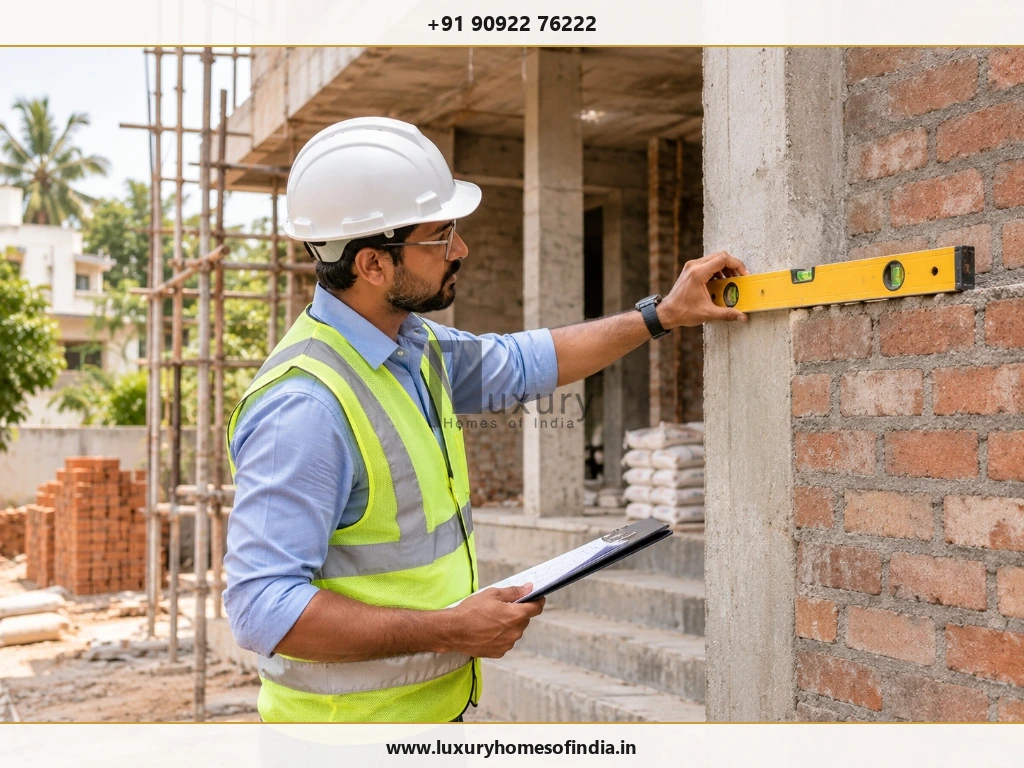
For a builder or contractor
- Request relevant completed-project references and permission to inspect work where available.
- Compare a detailed quotation with the BOQ and drawings.
- Confirm who will supervise the site and coordinate technical work.
- Establish who supplies materials and manages subcontractors.
- Agree on inspection points, progress records and quality documentation.
- Put payment milestones, variations, delays and defect rectification in writing.
For statutory definitions, consult the official RERA Act, 2016 and the relevant Tamil Nadu RERA authority. Whether a project requires registration depends on applicable law and the project's facts.
Related Professional Guidance: Read LHI's comprehensive guide on How to Choose a Luxury Home Builder in Chennai and Builder vs Architect vs Engineer: Who Do You Need?.
10. Frequently Asked Questions
Conclusion: Define the Role Before You Sign
The difference between a promoter, builder and contractor lies in the activities performed, the contractual scope and the responsibilities imposed by applicable law.
- Promoter: Associated with specified real estate development and sale activities, including relevant statutory obligations.
- Builder: Commonly manages construction delivery or develops property, depending on the business model.
- Contractor: Executes an agreed construction or specialist work package.
If you are planning an independent house in Chennai, begin by defining the design, budget, specifications and level of project management you need. Compare proposals on a like-for-like basis, identify exclusions and document responsibilities before work begins.
The best choice is not necessarily the party with the most impressive title or the lowest quotation. It is the arrangement that fits your project and makes responsibilities, quality checks, payments and changes clear.
Planning a Home Construction Project?
Before approaching a construction professional, prepare your plot details, approximate requirements, preferred scope and key design priorities. These details can help make an initial project discussion more productive.
Contact Luxury Homes of India
- Phone: +91 90922 76222
- Email: info@luxuryhomesofindia.in
- Address: #85, 4th Floor, Lotus Tower, Guindy, Chennai – 600032
- Website: luxuryhomesofindia.in
Disclaimer: This article provides general educational information, not legal, financial or engineering advice. Construction responsibilities and RERA obligations depend on the actual facts, contracts, applicable law and project structure. Seek appropriate professional advice before making legal or financial commitments.