House construction in Chennai can be delayed by incomplete drawings, building approval requirements, late material deliveries, labour coordination, unexpected site conditions, design changes and poor scheduling. Weather disruptions, payment disagreements and inadequate quality checks can also affect progress. The most effective way to reduce avoidable delays is to connect design, procurement, labour planning and site execution through a realistic construction programme.
Homeowners should finalise major specifications early, confirm who is responsible for each activity, track pending decisions and inspect critical work before the next stage begins. When a delay occurs, identify the activity holding up progress, assess which subsequent activities are affected and agree on a documented recovery plan.
No planning process can eliminate every unforeseen event, and approval or completion dates should never be treated as guaranteed. However, clear responsibilities, timely decisions and regular progress reviews give homeowners a more reliable way to manage their construction project.

Active residential construction site in Chennai: concrete structural framing, exterior scaffolding, masonry materials, and civil site coordination.
Quick Guide: What May Be Delaying Your House Construction?
Use this diagnostic table to identify the root cause behind common symptoms observed during residential construction:
| What You Notice | Possible Cause | What to Do Next |
|---|---|---|
| Work cannot begin | Pending approval, incomplete drawings or unresolved site information | Confirm the outstanding requirement and the responsible professional |
| Workers are waiting | Missing materials, unavailable trades or an unfinished preceding activity | Identify the blocked activity and confirm the next resource requirement |
| Completed work must be redone | Design changes, coordination errors or missed inspections | Document the defect, obtain technical advice and agree on corrective work |
| Finishing work is not starting | Pending selections, custom-product lead times or unfinished concealed services | Confirm approved specifications, delivery dates and readiness of the work area |
| The completion date keeps moving | An unrealistic schedule, unresolved dependencies or repeated changes | Request an updated programme with reasons, responsibilities and revised milestones |
These are diagnostic possibilities, not conclusions about a particular project. Confirm the actual cause before deciding on a corrective action.
1. The 12 Common Reasons for House Construction Delays
1. Incomplete Architectural and Technical Drawings
Construction may slow down when work begins before the architectural, structural, electrical and plumbing drawings have been coordinated.
For example, changing a bathroom layout after plumbing lines have been installed can require rework. Revising a staircase, structural opening or window position may affect several activities.
How to Prevent It
- Finalise the architectural layout and major specifications before starting the relevant work.
- Coordinate architectural and structural drawings.
- Plan electrical and plumbing routes before concealed services are installed.
- Keep a record of drawing revisions and communicate approved changes to the site team.
- Confirm that the site team is working from the current approved drawing set.
A coordinated set of drawings reduces avoidable uncertainty. Structural or service-related changes should be reviewed by the appropriate qualified professional.

Coordinated design drawings on desk: architectural floor plans, structural column rebar sections, and electrical/plumbing MEP routes reviewed before work begins.
2. Delays in Building Plan Approval
Building permission is an important milestone before construction begins. The applicable process depends on the property's location, building characteristics and relevant authority.
In Chennai, the Greater Chennai Corporation (GCC) and the Chennai Metropolitan Development Authority (CMDA) have distinct roles within the applicable approval framework. Homeowners should establish which authority and procedure apply to their property rather than assume that every application follows the same route.
In May 2026, reporting by The New Indian Express described a Greater Chennai Corporation direction prescribing a 27-day processing framework for relevant building-permit applications. This is dated, jurisdiction-specific context—not a universal guarantee for every approval or property.
How to Prevent It
- Confirm the applicable approval route with the registered professional handling the application.
- Check the required documentation and drawing specifications.
- Resolve site-detail and drawing discrepancies before submission where possible.
- Monitor the application and respond promptly to requests for clarification.
- Confirm that the required permission has actually been issued before treating the project as ready to proceed.
Source: The New Indian Express, 31 May 2026, “GCC sets 27-day deadline to approve building permit applications.”
3. Poor Construction Scheduling
House construction is a sequence of connected activities. Foundation work precedes the structural frame; service installation must be coordinated with masonry and finishes; and certain installations cannot proceed until the work area is ready.
Without a realistic programme, one team may arrive before another has completed its work, or a scheduled activity may be blocked by a missing decision.
How to Prevent It
Ask for a written, stage-wise programme that identifies:
- Planned start and finish dates.
- Major milestones and dependencies.
- Labour and subcontractor requirements.
- Material procurement and delivery dates.
- Inspection and approval points.
- Decisions required from the homeowner.
- The planned handover milestone and the assumptions behind it.
Review progress regularly. Update the programme when conditions change, recording why a milestone moved and what action is required.

On-site supervision: civil site engineer reviewing milestone schedule, trade dependencies, and masonry progress on active building site.
4. Late Procurement of Construction Materials
Ordering materials only when workers are ready to install them can create avoidable downtime. Tiles, natural stone, doors, windows, sanitaryware, lighting and custom kitchen components may have different selection, manufacturing and delivery requirements.
Availability and prices also change. These conditions should be confirmed with suppliers at the time of ordering rather than assumed from an older estimate or general market report.
How to Prevent It
- Prepare a procurement schedule alongside the construction programme.
- Confirm specifications, quantities and approved alternatives.
- Identify products with longer manufacturing or delivery periods.
- Obtain written supplier commitments where appropriate.
- Check delivered materials against the approved specifications.
- Plan secure storage for products delivered ahead of installation.
The objective is not to buy everything as early as possible. It is to have the correct materials available when the relevant work is ready.
5. Shortage or Poor Coordination of Skilled Labour
Construction progress depends on having the right trades available in the correct sequence. A delay in masonry can push back plastering; a plumber or electrician who is unavailable at the required stage can disrupt subsequent work.
Labour gaps may arise from competing commitments, poor planning or insufficient coordination between contractors.
How to Prevent It
- Plan labour requirements by construction stage.
- Confirm trade availability before scheduling dependent work.
- Set practical daily and weekly targets.
- Coordinate civil, electrical, plumbing and finishing activities.
- Review resource gaps before they affect critical milestones.
A productive site is not simply one with more workers. It is one where people, materials and work areas are ready when required.
6. Unexpected Soil or Site Conditions
Conditions discovered during excavation can affect the foundation programme. Examples include unexpected ground conditions, buried obstructions, groundwater, difficult site access and drainage issues.
Depending on the situation, additional investigation, design review or changes to the construction method may be necessary.
How to Prevent It
- Assess the plot and available site information before finalising the construction approach.
- Arrange soil investigation when required by the design or project conditions.
- Review drainage, access and existing utilities.
- Seek appropriate technical advice if actual conditions differ from the assumptions used for design.
No initial assessment can predict every condition. The goal is to identify significant risks early and respond to unexpected findings safely.
7. Repeated Changes to the Design
Moving a staircase, adding a bathroom, changing room dimensions or upgrading finishes after work has begun can affect multiple trades.
For example, a kitchen layout change may affect plumbing, electrical points, cabinetry and flooring. Work that has already been completed may also need modification.
How to Prevent It
- Agree on the main layout and specifications before the relevant work starts.
- Establish decision deadlines for major selections.
- Record requested changes in writing.
- Ask for the cost, technical implications and schedule impact before approval.
- Update the drawings and communicate the approved revision to the site team.
Changes may be worthwhile, but their consequences should be understood before implementation.
8. Payment Delays and Unclear Contractual Milestones
Construction relies on the coordination of labour, materials, subcontractors and equipment. A delay in an agreed payment may affect planned procurement or work allocation.
Disagreements can also arise when payment milestones are not defined clearly enough to establish what work has been completed.
How to Prevent It
- Use a written construction agreement.
- Define payment milestones in measurable terms.
- Clarify inspection, documentation and certification requirements.
- Maintain invoices, receipts and payment records.
- Record approved additional work and changes to payment terms.
- Discuss disputed items promptly and follow the agreement's resolution process.
The parties should work from documented obligations rather than informal assumptions.
9. Chennai's Monsoon and Weather Conditions
Rainfall can affect excavation, foundation activities, external plastering, waterproofing and exterior painting. Heavy rain may also affect access, drainage and the protection of stored materials.
The actual impact depends on the construction stage, site conditions and the protection measures available.
How to Prevent It
- Consider seasonal weather when preparing the construction programme.
- Provide suitable temporary drainage and site protection.
- Protect vulnerable materials from moisture.
- Schedule weather-sensitive activities with appropriate flexibility.
- Inspect affected work before proceeding with dependent activities.
Weather cannot be controlled, but its effect can be reduced through preparation and safe working decisions.
10. Poor Site Supervision and Quality Control
Errors are often more disruptive when they are discovered after another stage has covered or depended on the work.
Incorrect levels, misaligned walls, service-routing errors and inadequate waterproofing can require corrective work and rescheduling.
How to Prevent It
- Assign appropriate technical supervision.
- Inspect critical work before it is concealed.
- Use stage-specific checks for reinforcement, concrete, waterproofing and services.
- Maintain inspection records and dated progress photographs.
- Resolve identified defects before proceeding where the next activity would conceal or depend on them.
Quality checks should be scheduled as part of the work, not left until handover.
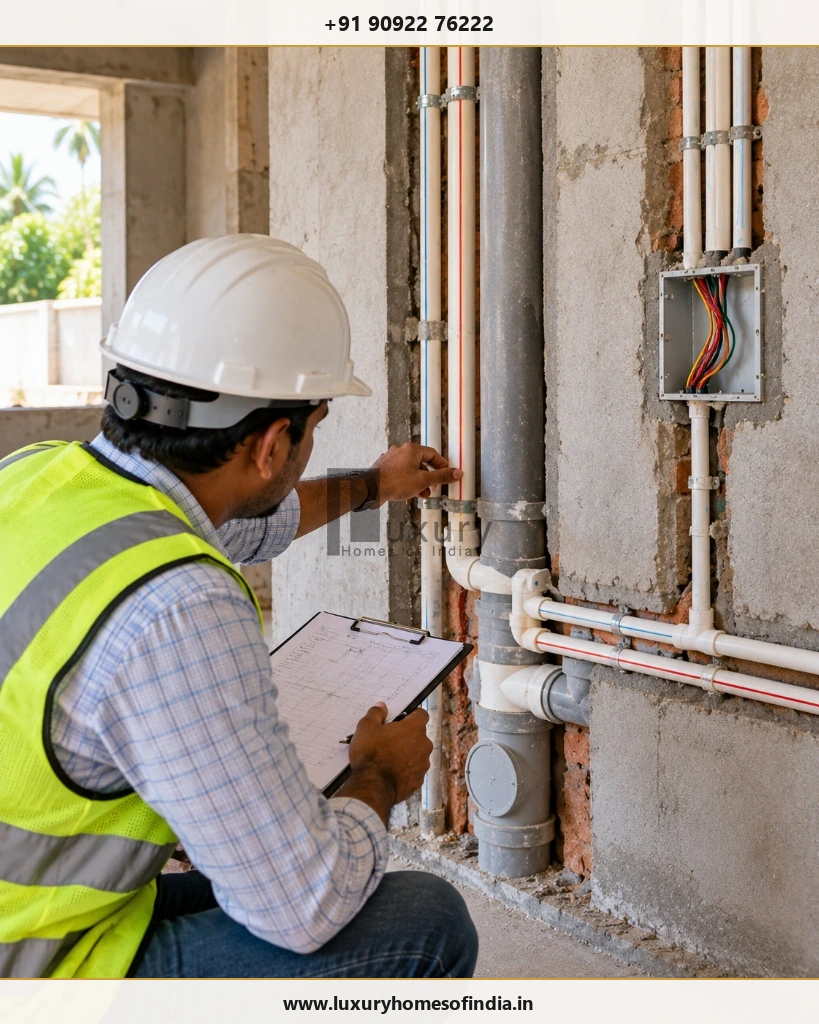
Quality control inspection: site engineer checking vertical plumbing lines, drainage conduits, and electrical junction boxes before plastering and wall enclosure.
11. Delays in Selecting Finishes and Approving Samples
Finishing decisions can remain unresolved while homeowners compare tiles, paint shades, lighting, doors, sanitaryware and kitchen components.
A late selection can delay ordering or installation, even when the site is otherwise ready.
How to Prevent It
- Create a finish-selection calendar.
- Agree on specifications, budget allowances and preferred alternatives.
- Review samples and product availability in advance.
- Record approved products and finishes.
- Confirm delivery dates before booking installation.
Early decisions give homeowners time to compare options without unnecessarily interrupting the finishing sequence.
12. Poor Communication Between Homeowner and Contractor
A construction programme can become difficult to manage when responsibilities, pending decisions and progress updates are unclear.
A material shortage may remain unresolved if it is not reported promptly. A contractor may also be unable to proceed because a required selection or approval is still pending.
How to Prevent It
- Hold regular progress reviews.
- Share dated progress reports and relevant photographs.
- Maintain a list of pending decisions and the person responsible for each.
- Record instructions, approvals and schedule changes.
- Escalate issues that could affect major milestones.
Clear communication makes it easier to distinguish completed work, blocked activities and actions that require attention.
2. How Construction Delays Affect Homeowners
A delayed completion date can affect more than the move-in plan. Prolonged timelines often ripple into unexpected household and financial challenges.
| Potential Impact | Why It Matters |
|---|---|
| Additional accommodation costs | Rent or temporary living arrangements may continue longer |
| Financing costs | Loan interest and repayments depend on the financing arrangement |
| Procurement changes | Product availability and quoted prices may change |
| Extended project expenses | Some labour, supervision and site costs may continue |
| Family arrangements | Relocation, schooling and other plans may need revision |
| Rework | Correcting defects can consume additional time and materials |
| Uncertainty | Repeated changes make planning more difficult |
The actual financial effect depends on the agreement, cause of delay, financing arrangements and additional work involved. Not every delay creates the same cost or contractual liability.
Homeowners should review their specific agreement and obtain appropriate professional advice where necessary.
3. What Should You Do If Your House Construction Is Delayed?
When progress slows, begin with a documented explanation rather than an unsupported assumption.
Step 1: Identify the Activity That Is Blocked
Ask the project team which activity cannot proceed and why. Is the problem a missing material, pending decision, incomplete preceding activity, technical issue, labour gap or approval requirement?
Step 2: Compare Actual Progress with the Programme
Check the original milestone dates against the current status. Identify when the delay first arose and which later activities depend on the affected work.
Step 3: Confirm the Corrective Action
Ask what must happen to unblock the activity, who is responsible and what resources or decisions are required.
Step 4: Resolve Pending Decisions
Confirm whether a drawing, material selection, payment, document or inspection is awaiting action. Address outstanding items within the agreed process.
Step 5: Record the Recovery Plan
Document the cause, corrective action, responsible person, target date and any impact on subsequent milestones.
Step 6: Review the Revised Completion Date
The revised programme should reflect the work remaining, supplier lead times, inspections, resource availability and relevant dependencies. An optimistic promise without supporting actions is not a recovery plan.
If a delay becomes a contractual dispute, review the signed agreement and seek appropriate professional advice.
A Simple Construction Delay Register
Use this register to document and track delay factors objectively:
| Item | What to Record |
|---|---|
| Delayed activity | The specific work that cannot proceed |
| Original target | The agreed milestone date |
| Current status | Completed, in progress or blocked |
| Cause | The confirmed reason or the issue still under investigation |
| Responsible person | The person tasked with resolving it |
| Corrective action | The agreed next step |
| Revised target | The proposed date and its assumptions |
| Follow-up | The next review date |
This register is a practical tracking template, not a substitute for the signed contract or a project-specific programme.
4. How to Prevent Construction Delays Before They Start
Preparation should connect design, approvals, procurement, execution and monitoring. Use this checklist before construction begins:
- Confirm the applicable building approval requirements.
- Complete and coordinate the required architectural and structural drawings.
- Plan electrical and plumbing layouts.
- Define the scope of work and bill of quantities (BOQ), where applicable.
- Agree on material specifications and allowances.
- Prepare a stage-wise construction programme.
- Define payment milestones and verification requirements.
- Identify materials requiring advance selection or ordering.
- Assign supervision and quality-control responsibilities.
- Establish progress reporting and review arrangements.
- Define how changes and additional work will be approved.
- Agree on a documented process for managing delays and revising the programme.
These steps cannot eliminate every unforeseen event. They can, however, make responsibilities clearer and problems easier to identify.
5. Why Construction Project Management Matters
A residential project involves interdependent activities, technical decisions, procurement commitments and inspections. Managing each element in isolation can create gaps between one stage and the next.
Each stage should have clear deliverables, an owner, a target date and defined dependencies. If an activity falls behind, the team should identify the cause, assess the effect on subsequent work and agree on a corrective action.
For homeowners, transparent records make it easier to understand progress, identify outstanding decisions and evaluate whether a revised completion date is realistic.
The right approach is not to promise that delays will never happen. It is to establish a process for preventing avoidable delays, identifying problems early and managing changes responsibly.

Project monitoring session: homeowner and project manager reviewing milestone tracking charts, material procurement schedules, and progress reports.
Frequently Asked Questions
Plan Your Home Construction with Greater Clarity
If you are planning a residential project in Chennai, begin with a clearly defined scope, coordinated drawings, a realistic budget and a construction programme suited to your property.
Luxury Homes of India invites homeowners to discuss their residential construction requirements and the planning and execution considerations relevant to their project.
Discuss Your Home Construction Requirements with LHI
Connect with our senior civil engineering team to review your architectural plans, establish milestone schedules, and implement proactive quality control on site.
Disclaimer: This article provides general educational information. Construction schedules, approval procedures and project costs vary by property, authority, design, contract and site conditions. Examples do not guarantee approval or completion dates. Confirm project-specific requirements with the relevant authority and qualified professionals.
Written by: LHI Editorial Team
Reviewed by: LHI In-House Technical Team